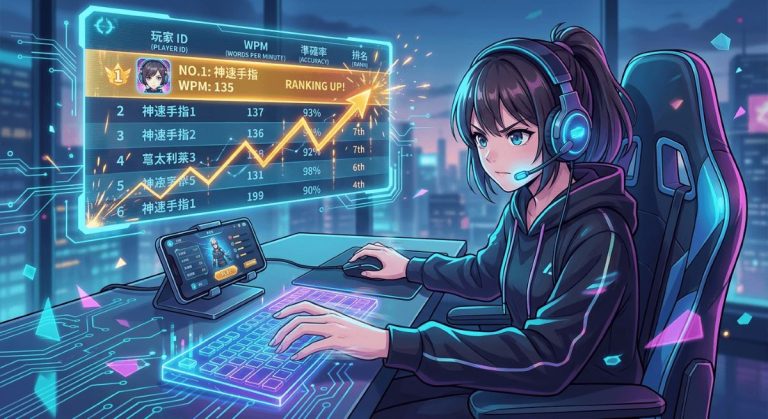
Skilled players may seem to react a fraction of a second faster than others, but what truly sets them apart is often more than just hand speed. Esports players must receive visuals, assess threats, predict opponents, adjust positioning, and make their next move based on teamwork every second. To understand one’s strengths and areas for improvement, a cognitive ability test that records reaction speed, memory, attention, and sensory performance is a very intuitive starting point.
For Taiwanese gamers, the pace of mobile games, MOBAs, FPSs, fighting games, card games, and puzzle games all differ, but they all require a stable set of mental abilities. These abilities are not innate or fixed, nor can they be completely acquired simply by playing ranked matches excessively. Truly effective practice involves identifying where you are slow, making mistakes, or getting distracted, and then using more specific methods to correct these errors.
Key Points Summary
Esports performance is typically comprised of reaction speed, focus, working memory, visual processing, decision-making, and emotional stability. Test scores can help players see their current level, but true improvement comes from real-game practice, reviewing replays, getting enough sleep, practicing quality, and teamwork.
Reaction speed is just the starting point, not the whole answer.
Reaction speed is the easiest thing to discuss because it’s very intuitive. If an enemy appears next to your crosshair, can you fire immediately? If a boss uses a red-circle attack, can you dodge it in time? In a fighting game, if your opponent shows an opening, can you counter-attack in a very short time? These things make people think that fast reaction time equals strength.
However, in actual combat, pure reaction usually only accounts for one part. The reason why experts are fast is because they have already understood the situation and even prepared their next move before the event occurs. This is very similar to the spectacular plays often seen in e-sports competitions . What the audience sees is the instant kill, but the player has already completed the vision assessment, skill cooldown estimation, and risk selection in their mind.
Several cognitive abilities most frequently used by esports players
Different games amplify different abilities. FPS games require visual searching and precise reactions, MOBA games require map awareness and resource judgment, card games test memory, probability, and long-term planning, and rhythm games require stable attention and rhythm prediction. The following abilities almost all affect a player’s potential and consistency.
- Reaction speed
is the time from seeing a stimulus to taking action. It affects dodging, follow-up shots, blocking, skill counter-attacks, and on-the-spot adjustments. However, a faster reaction time does not necessarily mean greater accuracy; being too hasty can lead to misclicks or misjudgments. - Selective attention
displays health, skills, cooldowns, map, enemy positions, and teammate signals simultaneously. It allows you to focus on the most important information, rather than being distracted by flashy effects or irrelevant actions. - Working memory
is like a temporary storage area in the brain. You need to remember whether the opponent has used their ultimate ability, where the enemy jungler might be, when your next wave of minions will arrive, and whether your teammates still have crowd control abilities. If you can’t remember these things, you’re more likely to make choices that seem reasonable on the surface but are actually very risky. - High-intensity visual processing capabilities
are essential for games with rapidly changing visuals. Players need to discern movement trajectories, skill ranges, projectile directions, character poses, and environmental obstructions. The more stable the visual processing, the more useful information can be gleaned from the chaotic visuals. - In esports, decision-making speed
is crucial; there’s no exam, and little time for slow analysis. Players often have to choose between pushing, retreating, providing support, switching lanes, initiating team fights, or playing it safe, all with incomplete information. Good decision-making isn’t about constantly taking risks, but about knowing when to act quickly and when to wait.
Different game genres require different skill configurations
If you use the same standard to measure all games, it’s easy to misjudge your own strengths and weaknesses. Some people have quick reflexes, but often forget their opponent’s possible solutions when playing strategy card games. Some people have excellent memories, but can’t find enemy locations in shooting games. Cognitive abilities only have real value when considered within the context of the game genre.
| Game type | Core cognitive abilities | Common mistakes |
|---|---|---|
| FPS shooting | Reaction speed, visual search, spatial awareness | The crosshair can’t keep up, the sound positioning is slow, and the position is revealed too early. |
| MOBA | Map awareness, working memory, team fight judgment | Ignoring the minimap, misjudging skill exchanges, getting caught while greedy in lane. |
| Fighting games | Prediction, reaction, pattern recognition | Defensive rhythm is read, combos are unstable, and players are tricked into making moves by feints. |
| Card Strategy | Memory, probability judgment, long-term planning | Only consider the gains in the current round, ignoring subsequent resources. |
Stable concentration leads to stable performance.
Many players think mistakes are due to poor hand-eye coordination, but actually, it’s because their attention has drifted off. In the late game, their eyes are on the screen, but their mind starts wandering. You might miss an enemy assassin disappearing, or fail to notice your teammates have run out of crucial skills. These kinds of mistakes aren’t due to a lack of skill, but rather a failure to maintain focus until the very end.
There are several practical training directions for stabilizing attention:
- Before each game begins, set a key observation point, such as the minimap, skill cooldowns, or the enemy’s core location.
- When reviewing a scenario, check for only one type of error; don’t try to fix all the problems at once.
- When you’re on a losing streak, stop and don’t let emotions get the better of you as you move on to the next match.
- Turn off irrelevant notifications during practice to reduce external distractions.
These methods may seem simple, but their effects are direct. If players can maintain their focus for longer, their actions will naturally be cleaner, and their judgments will be less influenced by emotions. This is the core principle repeatedly emphasized in many advanced player tips : truly skilled players don’t always perform amazing plays, but rather rarely make basic mistakes in simple situations.
How working memory affects team fights and map awareness
Working memory is easily underestimated in esports. Unlike reaction speed, it doesn’t provide immediate results, but it profoundly impacts the quality of your judgment. Take MOBAs as an example: if the enemy just used Flash, it means there’s an opportunity to counter it in the next few minutes. If the enemy jungler just appeared in the top side of the map, the bot lane can trade blows or push the lane. If this information isn’t remembered, it’s as if it never existed.
Team fights are no different. You need to remember who used their crowd control abilities, who still has mobility skills, and who seems to have safe health but actually lacks survival skills. The more information you have, the easier it is to overload your working memory. Skilled players don’t necessarily remember every detail, but rather grasp the most valuable information. For example, remembering only the enemy’s initiation skills, key summoner spells, and main damage dealer positions can significantly reduce mistakes in team fights.
Visual processing and prediction help you rely less on luck.
Some players always feel like they’ve been ambushed, or that enemy skills come too suddenly. In reality, many dangers are preceded by warning signs. Unnatural character positioning, a sudden absence of lane support near bushes, and the enemy support starting to push forward are all clues provided by the visuals and the overall situation. The better your visual processing skills, the better you can organize these scattered signals into actionable judgments.
Reaction time is often used in psychology to observe the speed of human information processing, and psychological timing is a common concept in this field. In gaming, this doesn’t mean players only need to pursue millisecond-level speed, but rather that they need to understand which stage—from seeing, understanding, choosing, to acting—is most likely to slow down their overall performance.
How should I interpret my test scores to avoid misjudging myself?
Online tests are great for observing trends, but they shouldn’t be the sole criterion. A poor score today could be due to lack of sleep, cold hands, internet latency, distraction, or simply a small sample size. A better approach is to take the test several times at fixed intervals, recording the average and fluctuations, rather than focusing solely on the highest single score.
Players can analyze the test results in three levels. First, basic abilities, such as reaction time consistency and memory retention. Second, changes in performance, such as a significant drop in score after staying up all night. Third, practical application, such as whether faster reaction times translate to fewer skill hits in the game. Only by considering all three aspects together does the score have meaning.
Incorporate cognitive training into daily practice
To improve cognitive abilities, you don’t need to turn gaming into painful training. The key is to make your practice purposeful. Doing just a little bit each day, but knowing what you’re practicing, is usually more effective than playing mindlessly for five hours straight. This is especially true for working professionals, students, or casual gamers who have limited time; they need to break their practice into smaller, manageable segments.
You can try this rhythm. First, spend five minutes doing a reaction or memory test to check your performance for the day. Then, go into a game and practice a specific skill, such as only practicing minimap observation, only practicing crosshair aiming, or only practicing skill switching. After playing two or three games, review a key mistake to find out if you missed information, couldn’t keep up with your memory, or made a hasty judgment. Doing this will leave traceable clues of improvement in each game.
Psychological state is also part of cognitive performance.
Esports players often talk about mechanics, but rarely about emotions. However, emotions directly impact focus and decision-making. When tense, you might miss flank threats. When angry, you might knowingly chase into the jungle. When afraid of being blamed, you might miss a team fight that should have been initiated.
Cognitive ability isn’t just cold, hard data about mental effort; it’s influenced by physical and mental states. Sleep, diet, posture, stress, and communication with teammates can all affect your processing speed in a game. Truly mature players consider state management as part of their skill set, rather than blaming a bad run of form after a loss.
Get your brain to keep up with your operational ambitions
The cognitive abilities essential for esports players are not a competition of single skills, but a holistic system. Reaction speed allows you to seize fleeting moments, attention lets you see the key points, working memory helps you retain crucial information, visual processing allows you to understand chaotic scenes, and decision-making ability translates all information into action. Only when these abilities are combined do they translate into consistent performance in actual combat.
To get better, don’t just ask yourself if your hand speed is fast enough. Also ask yourself if you’ve seen the necessary information, remembered key cooldowns, and made reasonable choices under pressure. When you start to understand your brain in a more nuanced way, game practice is no longer just about accumulating games, but about gradually transforming your potential into the ability to truly win matches.